The Constellation Paradox: Building an Empire on Earned Constraints
The paradox of Constellation Software (CSI) is their ability to grow to $100B with a theory of constraints. In 1995, Mark Leonard raised $25 million to acquire and hold boring, niche software companies. Thirty years and over 1,000 acquisitions later, that decision has produced one of the most successful track records in modern business history.
This essay deconstructs the source code of that success. We will move beyond the surface-level story to reveal a counter-intuitive operating system built on “earned secrets” and powerful constraints. You will not only understand how they did it, but also see a framework for how extreme discipline creates extraordinary value.
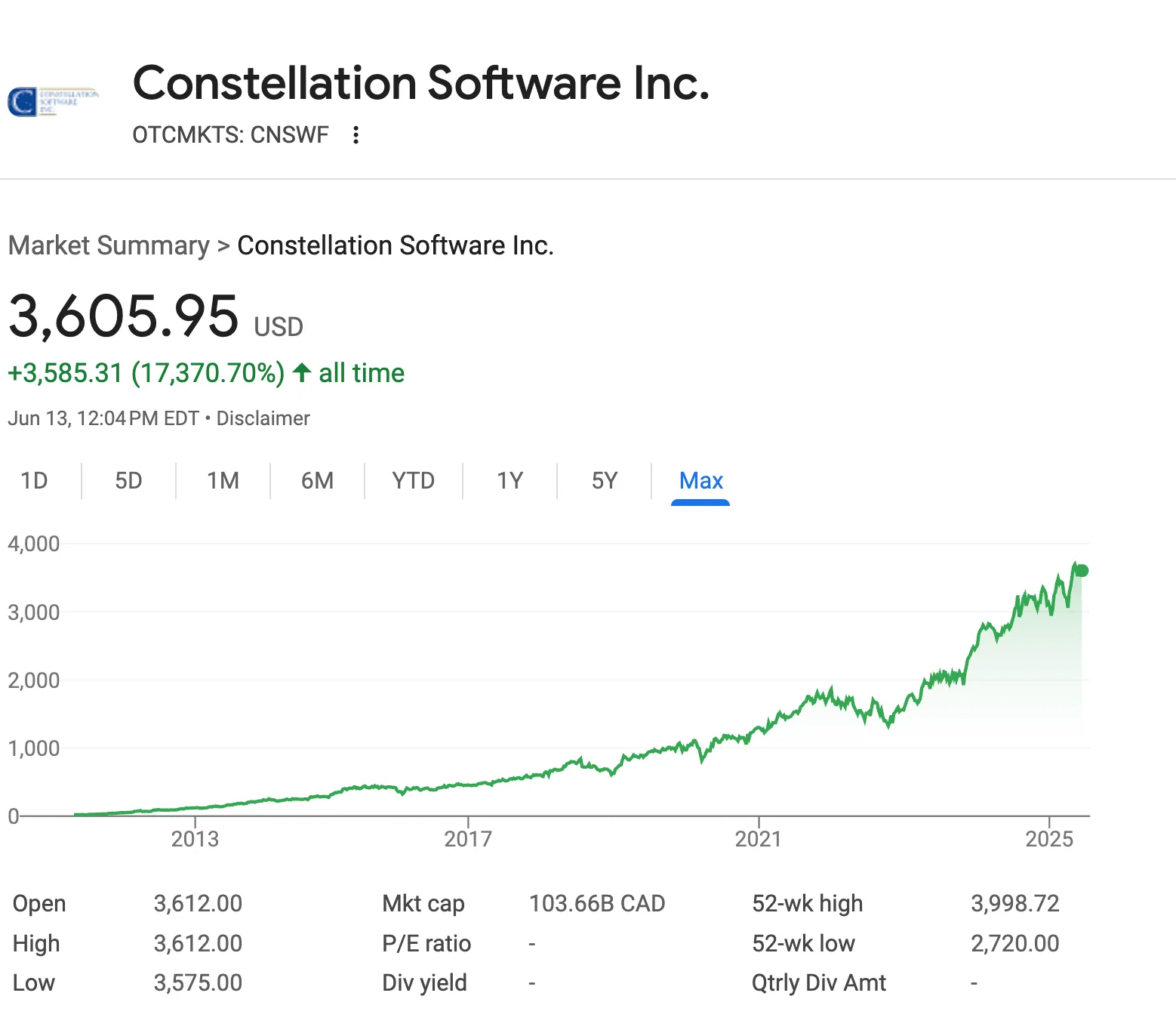
The founder’s genius, “hold forever”, and decentralized structure all pieces to the puzzle. The real engine is more counter-intuitive. Constellation’s returns are forged by a system of self-imposed constraints. These are not arbitrary rules; they are disciplines built upon hard-won, earned secrets about value, people, and time. By codifying these secrets into constraints, they built a perpetual value machine competitors, obsessed with upside, cannot replicate.
§Constraint #1: The Target (Good, Not Great)
The first earned secret: incumbent vertical market software (VMS) businesses possess profound durability. They enjoy monopoly-like dynamics, high margins, and deep customer lock-in. They are cash-rich and require little capital to defend their moats. The resulting constraint is a strict choice of prey. Constellation focuses on acquiring the top players in these tiny markets. Post-acquisition, the mission is not to chase hyper-growth. The mission is to fortify the moat and never stumble.
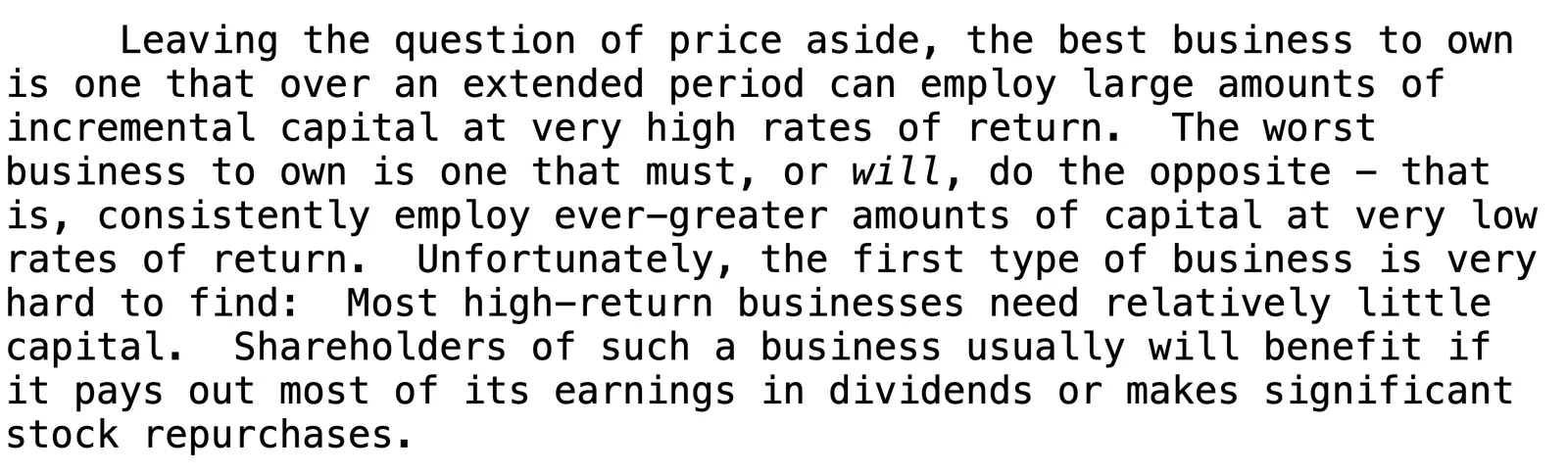
This creates a “first-world problem.” These cash-gushing monopolies have limited opportunities for internal reinvestment. What good are 40% margins if the cash has nowhere productive to go? This model opposes the classic ideal of a business able to reinvest large amounts of capital at high rates of return1. This “flaw” is the catalyst for the entire model. It forces them to master a harder, scalable problem: how to become experts at reinvesting capital outside the business.
§Constraint #2: The People (Investors are Manufactured, Not Found)
The second earned secret: genius does not scale, but systems do. Relying on a once-in-a-generation talent is a strategy of hope, not a business model. Leonard’s true masterwork is building a factory for investors. The resulting constraint is the removal of individual “artistry” in favor of a rigid, scientific framework. Capital allocation is pushed to the lowest possible level, where M&A teams operate with quantifiable rules. Armed with proprietary data from over 1,000 acquisitions and ten times more they passed on, they refine their underwriting. And now you have enough data to check on the assumptions made to hit a 20% hurdle rate.
This turns capital allocation into a science. The excess cash from the “good, not great” businesses is reinvested to manufacture more capital allocators. They understood the incremental returns on a new, disciplined investor were higher than forcing cash into a mature product. They built a people-compounding machine.2
§Constraint #3: The Timeline (The Permanent Hold)
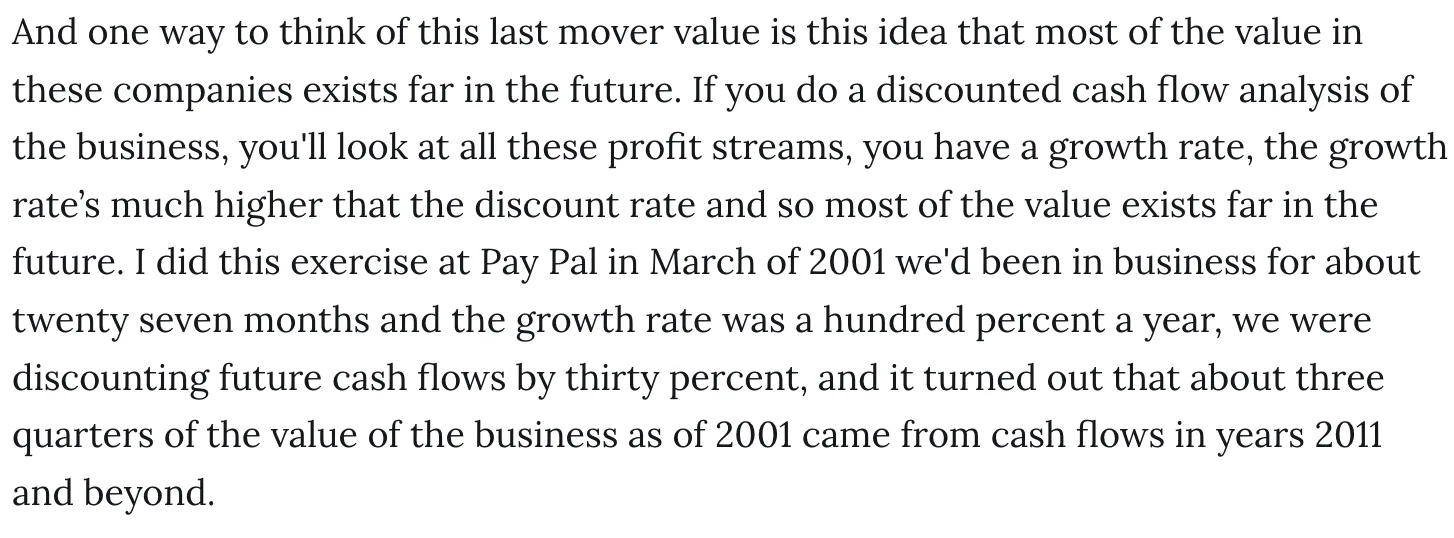
The final, most powerful earned secret is twofold: great value is unlocked over decades, and humans are wired to sell too soon. The temptation to cash in a winner is immense. Taking profits feels safe, a powerful impulse to overcome.A forced constraint, like a lock-up period3 in an excellent business, can be a hidden blessing, compelling owners to hold through volatility and into greater returns.
Plus, the added benefit of having an infinite timeline means you will see more opportunities, you can afford to spend a decade learning about, underwriting, and engaging with the management team of a software company. When the “sale” sign is put outside, CSI becomes an obvious suitor.
Constellation’s refusal to sell is a deliberate, system-wide version of a lock-up—an insurance policy against human weakness. It is built on this core thesis: the market—including themselves—undervalues the terminal value of an incumbent VMS business. Therefore, the only logical move is to pay a fair price and capture the massive, hidden value by refusing to sell. You cannot capture this value if you sell early.
They learned the cost of violating this rule the hard way. The only business they sold, a portion of their transit unit, earned on a standalone basis nearly eight times what Constellation sold it for a few years later. It was a disastrous, but invaluable, lesson.
§The Inevitable Trade-Offs
This constrained system requires sacrifices. These are not failures; they are the necessary price of admission.
- Stifled Organic Growth: A deliberate trade. They sacrifice entrepreneurial innovation within their companies for capital allocation excellence across their portfolio.
- Missed Opportunities: A rigid adherence to valuation is a guardrail against arrogance. Some trophies will get away, but it prevents catastrophic mistakes.
- The People Problem: The machine is designed to train investors, not to satisfy the ambitions of builders. This is the model’s primary, unresolved tension.4
§Why the Copycats Are Doomed to Fail
Understanding Constellation’s earned constraints makes it obvious why imitators fail. They copy the tactics but flinch from the painful discipline those tactics demand. They haven’t internalized the earned secrets.
- They overpay, lacking the rigid valuation framework built on decades of data.
- They centralize power with “gurus,” failing to build the scalable people factory.
- The critical flaw: they sell. Trapped in an unattractive structure, they are forced to exit, giving their thesis a different take than what Constellation does.
They see the upside of the model, but are unwilling to live with the limits.
Constellation Software is a type of Rorschach test. Understanding their model is easy. The hard part is confronting what it reveals about ourselves…our own appetite for glamour, impatience, and unwillingness to be boring.
—
§OK I’ve gotten a lot of questions from you all. In the case of a follow-up post. Please email in questions (mylesmarino1@gmail.com) or DM them on Twitter so I can consolidate them
Footnotes
-
This is one of Buffett’s best quotes. Notice how few companies can fit this description over the long term. ↩
-
Similar to the Thiel, Robertson, and Munger school of investing in people. There are of course non-financial greats in this as well such as Lorenzo de’ Medici and Gertrude Stein. ↩
-
Think how rich the executives at Facebook would be if they held on post-IPO instead of dumping as soon as the lockup ended. ↩