Find Your Guy
In 1950, a nineteen-year-old in Omaha read The Intelligent Investor and found his guy.
He received a Harvard rejection later that year. He wasn’t quite Harvard Man material. But the author of The Intelligent Investor was teaching at Columbia, so he enrolled and moved to New York to follow his newfound Guy. He got the only A-plus of Ben Graham’s class, and suggested he join Graham’s firm, for free. He was rejected. So he found other ways in.
His teacher was the chairman of a small, accidentally public insurer, GEICO. One Saturday in 1951, the young student took a train to Washington, D.C. and knocked on the door of the company’s headquarters. Since it was a Saturday, the building was nearly empty. A janitor took pity and let the traveler in, where he met Lorimer Davidson. Davidson had joined GEICO three years earlier, and he was the one who brought Graham in as an investor. Buffett sat down with Lorimer and they talked for four hours.
After Buffett returned to New York, he put two-thirds of his savings into GEICO.
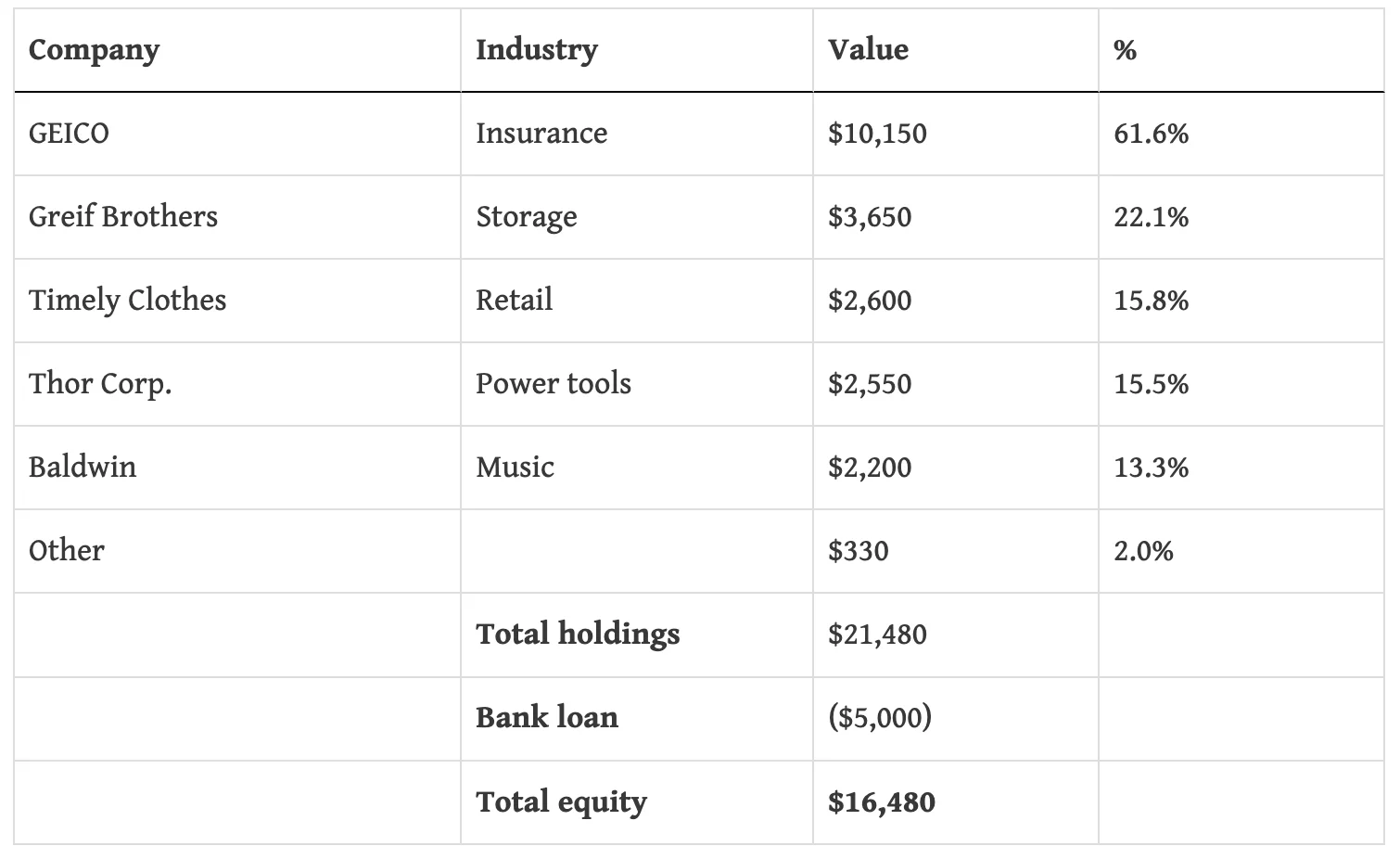
Buffett’s personal portfolio in the early 1950s. Via FutureBlind, courtesy of Robert Miles.
He kept writing to his teacher, pitching him ideas, offering to convert to Judaism1, and repeating his offer to work for free. It took three more years for Graham to cave. Buffett moved his family to New York, and pulled up a seat right next to his idol. Later that year, his first son was born. He named him Howard “Graham” Buffett.
—
Most of the giants we think of as original did some version of this. Sam Walton professed, “Most everything I’ve done I’ve copied from somebody else.” Jim Sinegal talks about how everything he learned was from Sol Price. Bobby Knight was pitching plays to Pete Newell across index cards. Steve Jobs echoed his idol Edwin Land when he launched the iPad and declared Apple was trying to “be at the intersection of technology and liberal arts.”
None of them were trying to be original. They picked one person and tried to become them.
They never stopped once they achieved eye-level status with their idol. Most blew by their heroes, and found new ones. They always kept the core ideas but twisted them a tiny bit. They tweaked them to perfection and created their Natural Path by injecting their own personality and strengths into the model they lifted off another. Sol Price popularized the idea of members-only clubs by restricting them to certain government employees and businesses. Sinegal adopted the core idea, but tweaked it so regular consumers were just as welcome as business people. But the echoes of Sol Price remain: in the early mornings, Executive and Business Members continue to receive a bit more luxury from Costco.
This bothers me, because I wrote the opposite down years ago: “Don’t copy others’ games. If you play others’ games, you will lose.” I still think that is right. But if I rewrote it there would be a few more sentences there. The object isn’t to copy, the object is to win. And in service of winning, one may indeed copy.
Buffett never copied Graham’s life (multiple wives aside) or his portfolio (Buffett shot for higher returns). He copied how Graham thought about price and value. Sam Walton did not copy his competitors’ locations or their merchandise mix, only their shelving space and accounting. Envy is about copying the outcome. Apprenticeship is copying the work, all while steering toward the desired outcome.
In 2023, I went to the Berkshire annual meeting and met many, many investors, many of whom could parrot Buffett quotes better than I. The most successful investors I met were not copying Berkshire. They were building something Natural to themselves. The holding companies were rarely insurance based, but instead were built around the business they knew best. The best were taking Buffett’s lessons but applying them to obscure markets, or expanding beyond the two-partner model Berkshire has had and disseminating to other partners.
Look closely at almost everyone you admire, and you will find they are 80% somebody else. Nobody grew up on a Galápagos island, away from the rest of their crowd, and found the answers from first principles. They realized some heroes had already built a great foundation, and just copied them. The final 20%, their style, comes later and only works because of the 80% foundation underneath it.
Being original is overrated. Find your guy, build the foundation, and tweak where most natural.
—
In 1976, Ben Graham died. That same year, GEICO came to the brink of insolvency, and the stock fell from $61 to $2. It was not a low-book-value formula or a last cigar butt, or anything else Ben Graham would have recognized. Warren Buffett stepped in, and bought about a quarter of the convertible preferred stock that kept GEICO above water.
This was not a Graham-like bet. It came from the Saturday in 1951, when Davidson spent four hours talking young Buffett through the insurance business: you take premiums now, pay claims later, and invest the money in between. With this bet, Buffett finally stood eye-level with Graham, and then kept going. Now, Buffett was the Guy.
Footnotes
-
Graham-Newman Corporation was all Jewish at the time. ↩